Extrusion‑Wound Monolithic Construction
Our cylindrical tanks are manufactured using the same proven, industrial‑grade process that defines Houston PolyTank engineering:
- Seamless, monolithic construction
- No panel joints or stress‑prone weld seams
- Uniform wall thickness for structural stability
- Superior resistance to chemical attack
- Long‑term reliability in high‑stress applications
The Industry Standard for Extrusion‑Wound Cylindrical Tanks
Houston PolyTank designs and manufactures high‑performance HDPE and PP cylindrical tanks engineered for industrial and municipal systems that demand long‑term reliability. Our extrusion‑wound, monolithic construction eliminates weak points, resists corrosion, and delivers superior performance compared to steel, stainless steel, fiberglass, and rotomolded plastic tanks.
Each tank is built as a single, seamless structure, extrusion‑wound under controlled conditions to achieve uniform wall thickness, exceptional hoop strength, and long‑term durability in aggressive environments.
This construction method is what makes Houston PolyTank the engineering authority in cylindrical HDPE and PP tank manufacturing.
The Industry Standard for Extrusion‑Wound Cylindrical Tanks
Houston PolyTank designs and manufactures high‑performance HDPE and PP cylindrical tanks engineered for industrial and municipal systems that demand long‑term reliability. Our extrusion‑wound, monolithic construction eliminates weak points, resists corrosion, and delivers superior performance compared to steel, stainless steel, fiberglass, and rotomolded plastic tanks.
Each tank is built as a single, seamless structure, extrusion‑wound under controlled conditions to achieve uniform wall thickness, exceptional hoop strength, and long‑term durability in aggressive environments.
This construction method is what makes Houston PolyTank the engineering authority in cylindrical HDPE and PP tank manufacturing.

Engineered for Harsh Chemical and High‑Temperature Environments
Every cylindrical tank is designed to perform in conditions where traditional materials fail. Ideal applications include:
- Chemical storage and processing
- High‑specific‑gravity materials
- Industrial wastewater and treatment systems
- Continuous‑duty operations
- Corrosive and high‑temperature environments
- Municipal and industrial containment systems
Our tanks are engineered to deliver consistent performance in the most demanding operating conditions.
For engineers working with aggressive chemicals, high‑specific‑gravity materials, or continuous‑duty industrial systems, this guide provides a technical overview of tank design, material performance, and configuration options.
Download: Industrial Tank Engineering Guide (PDF)
Material Selection for Performance and Temperature
We engineer each tank using the optimal material for its operating conditions:
- High‑density linear polyethylene (HDPE) for applications up to 120°F
- Polypropylene (PP) for high‑temperature applications between 180°F and 200°F
Material selection is based on chemical compatibility, working temperature, specific gravity, structural loading, and application environment – ensuring long‑term reliability from day one.

Structural Strength and Wall Thickness
With wall thicknesses ranging from ½ inch to 3.5 inches, our cylindrical tanks deliver:
- High structural rigidity
- Excellent impact resistance
- Superior chemical resistance
- Longer service life than steel, fiberglass, and rotomolded tanks
This is engineered infrastructure. Not a commodity tank.
Tank Configurations and Design Options
Cylindrical tanks are engineered in capacities ranging from approximately 50 gallons to 50,000 gallons, depending on material selection, wall thickness, and application requirements. Larger custom configurations may be available based on engineering review.
Vertical Tanks
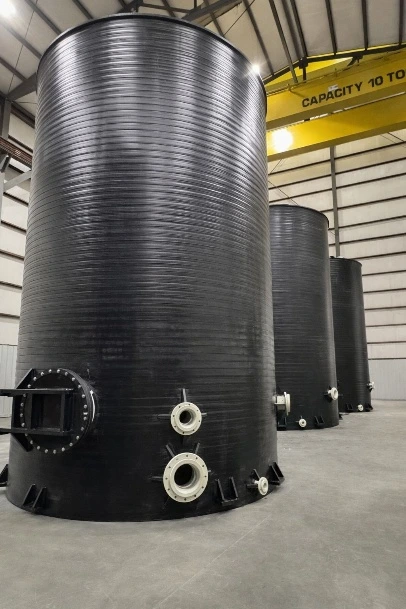
Large-diameter vertical cylindrical tank, extrusion-wound construction.
The horizontal ribbing/banding is a hallmark of Houston Polytank's fabrication method. The layered extrusion winding provides structural strength and wall integrity from top to bottom.
Horizontal Tanks
Custom polypropylene horizontal cylindrical tank engineered for industrial chemical storage.
This design was built to withstand 30 PSI above atmospheric pressure for demanding process environments.

Applications
Houston PolyTank cylindrical tanks are ideal for:
- Chemical processing
- Industrial storage
- Water and wastewater treatment
- High‑specific‑gravity materials
- Harsh chemical environments
- High‑temperature process systems
- Municipal and industrial containment
